A major controversy has erupted involving a senior Doordarshan News anchor who publicly labeled a Delhi-based Class 12 student as “Pakistani” on social media. The student had created an account to flag a massive CBSE answer sheet mix-up. Following intense public backlash and verification of the student’s identity, the anchor deleted his post and issued a formal apology, while the CBSE eventually corrected its evaluation error.
TL;DR:
A Doordarshan anchor has sparked controversy by calling a Delhi student ‘Pakistani’ after the student raised concerns about CBSE examination marking. This incident has drawn attention and criticism, highlighting the sensitivity around national identity and education issues in India.
Public broadcaster Doordarshan has come under heavy scrutiny after one of its senior primetime anchors targeted a Class 12 student from Delhi who was raising legitimate concerns about his board examination results. The anchor publicly questioned the student’s nationality, sparking a wave of online harassment. The incident has drawn widespread criticism from parents, educators, and media watchdogs, bringing the ethical standards of public sector broadcasting into sharp focus.
The Root Cause: A Massive CBSE Paper Mix-Up
The controversy began when Vedant Srivastava, a Class 12 student from Delhi, received his results from the Central Board of Secondary Education (CBSE) and noticed an unexpectedly low score in his Physics paper.
The Re-evaluation Discovery: Seeking clarity, Vedant applied for a photocopy of his evaluated answer sheet through the official CBSE re-evaluation portal.
The Error: Upon downloading the document, he was shocked to find that the scanned Physics answer sheet uploaded under his roll number was completely unfamiliar—the handwriting did not match his own, indicating an institutional mix-up.
The Platform: To draw urgent attention to his problem amidst broader technical glitches plaguing the CBSE portal, Vedant and his brother, Siddhant Srivastava, created a new account on X (formerly Twitter) specifically to flag the issue to authorities.
The Controversy: How a Student Grievance Became an “Anti-National” Accusation
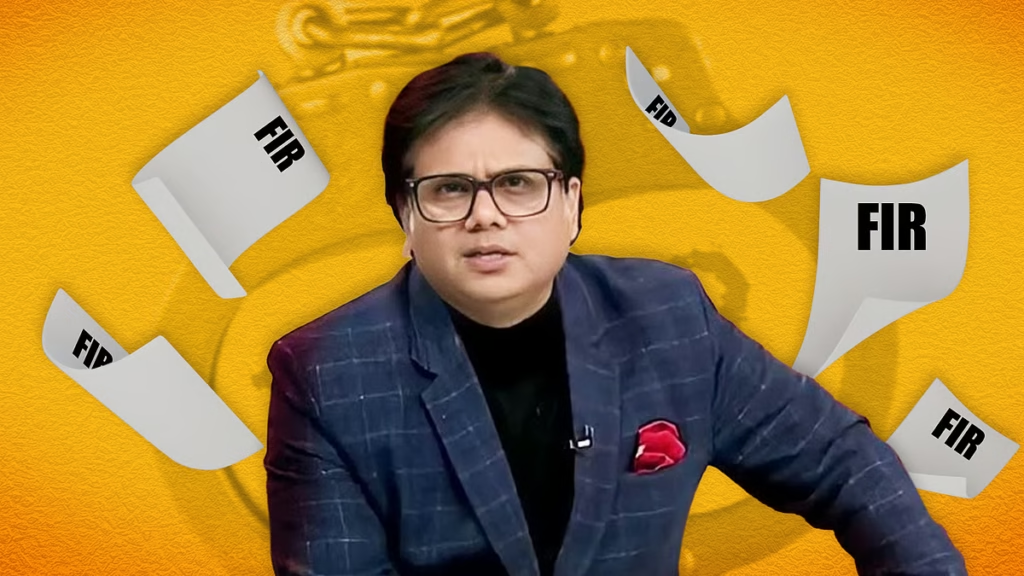
The institutional failure quickly turned into a personal nightmare for the student due to a social media post by Ashok Shrivastav, the host of DD News’ primetime show Do Took.
The Location Glitch
When a user opens a brand-new account on X, the platform often defaults the account’s broad regional location to “South Asia” before a specific country or GPS data is localized.
Spotting Vedant’s viral post, the Doordarshan anchor shared screenshots of the student’s newly made profile, highlighting the “South Asia” location marker. Relying strictly on this technical detail, the anchor publicly posted: “Did Pakistanis also appear for the CBSE exam?!!”
This accusation triggered a massive wave of online trolling, with several users labeling the stressed teenager and his family as “anti-national” and “Pakistani” trolls simply for requesting an accurate evaluation of his board exam.
Institutional Backlash and Apology
As the story gained traction, independent fact-checkers like Alt News and national media outlets stepped in to verify the family’s credentials.
Family Clarification: Vedant’s brother publicly defended him, clarifying that the account was created solely for the exam grievance because the official re-evaluation portal had been unresponsive.
The Anchor’s Retraction: Following widespread condemnation, Ashok Shrivastav deleted the controversial tweet and issued a formal apology to Vedant and his family for the distress caused by the erroneous information.
CBSE Corection: On May 25, CBSE officials formally acknowledged the clerical mix-up, reached out to Vedant, and emailed him his actual, corrected Physics answer script.
Conclusion: A Growing Debate on Systemic Failures
While the immediate issue for the student has been resolved, the incident has highlighted a more systemic crisis. Vedant’s grievance occurred against the backdrop of mounting national pushback regarding the CBSE’s newly introduced On-Screen Marking (OSM) system, which has faced severe criticism over blurred scans and incorrect totals this year. Furthermore, the incident serves as a cautionary tale regarding media ethics, demonstrating how easily a public broadcaster’s platform can mischaracterize a student’s genuine institutional grievance into a geopolitical conspiracy.
