The prospect of open conflict between the United States and Iran has once again emerged as a central concern in global affairs. While a formal declaration of war has not occurred, a series of military exchanges, proxy confrontations, cyber operations, and escalating rhetoric in recent months have brought the two longtime adversaries closer to direct confrontation than at any point in recent years. From the waters of the Persian Gulf to battle-scarred territories in Iraq and Syria, the consequences of miscalculation loom large.
Officials on both sides publicly state that they do not seek a full-scale war. Yet analysts warn that the accumulation of tit-for-tat actions, regional proxy engagements, and strategic mistrust has created a volatile environment in which a single incident could trigger broader hostilities. The situation has drawn concern from global markets, international institutions, and regional governments wary of the far-reaching implications of conflict.
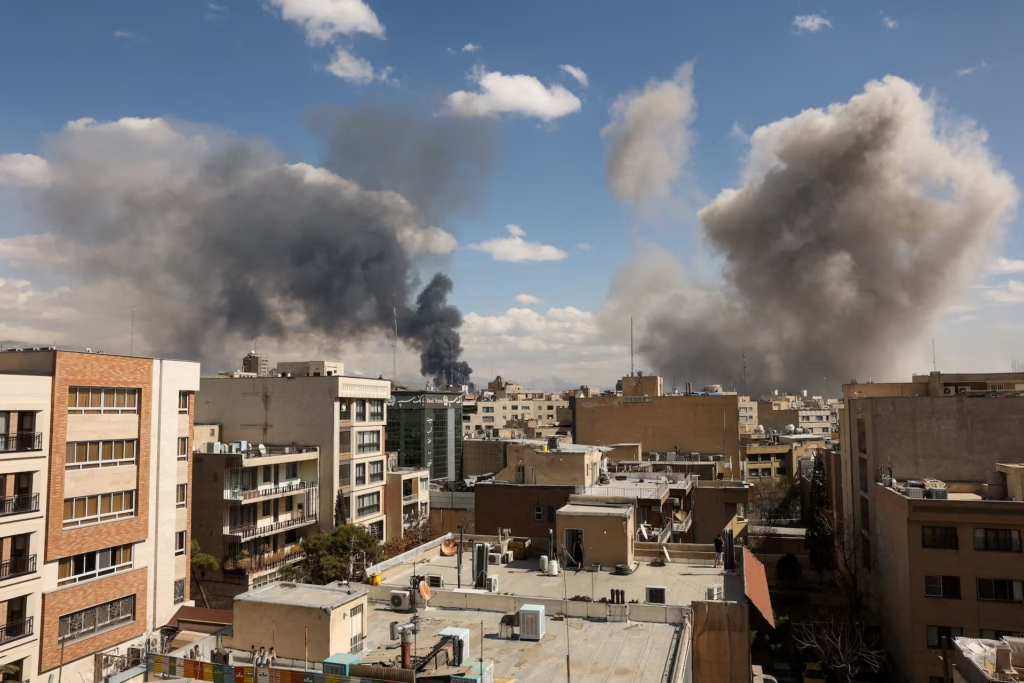
ESCALATING MILITARY EXCHANGES IN THE REGION
Recent months have seen intensified exchanges between U.S. forces and armed groups aligned with Tehran across the Middle East. American military installations in Iraq and Syria have faced drone and rocket attacks attributed by U.S. officials to militias supported by Iran. In response, the U.S. military has carried out airstrikes targeting weapons depots, command centers, and facilities allegedly linked to Iran’s regional network.
The U.S. Department of Defense, headquartered at the Pentagon, has described these strikes as “defensive and proportionate,” aimed at protecting American personnel stationed in the region. American officials have emphasized that the operations are not intended to expand into a broader war but are designed to deter further attacks.
Iranian leaders, meanwhile, have denied direct involvement in some of the militia operations while defending what they describe as legitimate resistance against foreign military presence. Tehran has warned that continued U.S. strikes risk destabilizing the region further. Statements from Iran’s military establishment, including figures within the Islamic Revolutionary Guard Corps, have underscored the country’s readiness to respond if its sovereignty or interests are directly targeted.
MARITIME SECURITY AND THE STRAIT OF HORMUZ
One of the most strategically sensitive flashpoints remains the waterways surrounding Iran, particularly the Strait of Hormuz and the Gulf of Oman. These routes are critical for global energy supplies, with a significant portion of the world’s oil shipments passing through them daily.
In recent incidents, commercial vessels have reported harassment, seizures, or drone surveillance in these waters. The U.S. Navy has increased patrols in coordination with allied forces, citing the need to ensure freedom of navigation. Iranian authorities, for their part, argue that their actions are consistent with regional security enforcement and have accused Western powers of militarizing the Gulf.
Energy markets have reacted sharply to each reported encounter. Even without a declared war, insurance costs for shipping have risen, and oil prices have experienced periodic spikes in response to fears of disruption. Analysts note that any sustained conflict affecting the Strait of Hormuz would have immediate and profound consequences for global energy stability.
THE SHADOW WAR AND REGIONAL PROXIES
The confrontation between Washington and Tehran rarely unfolds as direct combat. Instead, it is often characterized as a “shadow war” fought through proxies and indirect means. Tensions have been heightened by ongoing hostilities involving Israel, which has conducted strikes targeting Iranian-linked assets in Syria and elsewhere. Iran has vowed to defend its regional partners, raising the risk that local conflicts could draw in larger powers.
In Yemen, the activities of the Houthi movement, formally known as Ansar Allah, have added another dimension. The group’s attacks on shipping in the Red Sea have prompted U.S.-led naval responses. Washington has asserted that Iran provides material support to the Houthis, an allegation Tehran disputes.
Regional governments have expressed concern that these interconnected conflicts are creating a lattice of instability. Diplomatic observers warn that the cumulative effect of these proxy engagements increases the possibility of direct confrontation between the U.S. and Iran, particularly if casualties mount or high-value targets are struck.
— Donald J. Trump (@realDonaldTrump) March 2, 2026
NUCLEAR TENSIONS AND DIPLOMATIC STALEMATE
Beyond military clashes, the dispute over Iran’s nuclear program remains a central source of friction. The collapse of the Joint Comprehensive Plan of Action (JCPOA) framework in previous years left a diplomatic vacuum that has proven difficult to fill. Efforts to revive negotiations have stalled, with both sides accusing the other of inflexibility.
The International Atomic Energy Agency has reported that Iran has increased uranium enrichment levels beyond limits set under the 2015 agreement. While Tehran maintains that its program is for peaceful purposes, U.S. officials argue that the accumulation of highly enriched uranium shortens the timeline for potential weapons capability.
Statements from the White House have emphasized that diplomacy remains the preferred path but that “all options remain on the table” to prevent Iran from acquiring a nuclear weapon. Iranian Supreme Leader Ali Khamenei has reiterated that Iran does not seek nuclear arms, while condemning sanctions and external pressure.
The nuclear issue adds a strategic layer to military tensions. Experts suggest that any direct military exchange could further derail diplomatic channels and accelerate nuclear developments, complicating efforts to restore oversight mechanisms.
DOMESTIC POLITICAL CALCULATIONS
Domestic politics in both countries influence decision-making. In Washington, President Joe Biden has faced pressure from lawmakers across the political spectrum to balance deterrence with restraint. Some members of Congress advocate a firmer stance against Iranian-backed groups, while others caution against entanglement in another prolonged Middle Eastern conflict.
In Iran, economic challenges exacerbated by sanctions have shaped the leadership’s approach. Officials frequently frame regional resistance as essential to national security and sovereignty. Public opinion within Iran reflects a complex mix of nationalism, economic frustration, and wariness about escalation.
Political analysts observe that leaders on both sides must navigate internal constituencies while managing external threats. Missteps driven by domestic political considerations could unintentionally escalate tensions.
INTERNATIONAL REACTIONS AND DIPLOMATIC EFFORTS
The international community has sought to de-escalate the situation. The United Nations has called for restraint and renewed dialogue, warning that further escalation could destabilize not only the Middle East but also global economic and security systems.
European governments have attempted to mediate discussions around the nuclear issue, while regional powers have pursued cautious diplomatic engagement with Tehran. Recent years have seen tentative efforts at rapprochement between Iran and certain Gulf states, though these developments remain fragile amid renewed tensions.
China and Russia, both maintaining relations with Tehran, have criticized unilateral sanctions and advocated for multilateral solutions. Meanwhile, U.S. allies in the region continue to coordinate defense strategies while urging diplomatic resolution.
ECONOMIC IMPACT AND GLOBAL MARKETS
Even absent a formal war declaration, the confrontation has tangible economic consequences. Sanctions targeting Iran’s oil exports and financial institutions remain in place, limiting the country’s economic recovery. In turn, Iran has sought alternative trade arrangements and closer ties with non-Western partners.
Global markets are highly sensitive to developments in the Gulf. Energy analysts warn that sustained military exchanges or a blockade of key waterways would likely trigger sharp increases in oil prices, affecting inflation and economic stability worldwide.
Shipping companies have adjusted routes and increased security measures in response to perceived threats. Insurance premiums for vessels operating in high-risk zones have risen, adding to operational costs. These economic reverberations underscore the interconnected nature of regional security and global commerce.
RISKS OF MISJUDGMENT AND ESCALATION
Security experts caution that the greatest danger may lie not in deliberate war planning but in accidental escalation. Drone warfare, cyber operations, and rapid retaliatory strikes compress decision-making timelines and increase the possibility of error.
A strike that causes significant casualties or damages critical infrastructure could provoke a broader response. Military planners on both sides appear aware of these risks, yet the fluid nature of proxy engagements complicates command-and-control dynamics.
The absence of direct diplomatic channels between Washington and Tehran further heightens concern. Without sustained communication, misunderstandings may go unaddressed until they escalate into larger confrontations.
CONCLUSION: A PRECARIOUS BALANCE
The evolving confrontation between the United States and Iran illustrates the complexity of modern geopolitical rivalry. While neither side has declared war, the pattern of military exchanges, nuclear tensions, and proxy conflicts has created a precarious balance. Strategic waterways remain vulnerable, regional allies are on alert, and global markets respond to each development with apprehension.
Diplomatic pathways remain open but fragile. The stakes extend beyond bilateral relations, encompassing regional stability, energy security, and the broader international order. As events continue to unfold, policymakers face the challenge of deterring aggression while avoiding actions that could ignite a larger war.
For now, the situation remains defined by controlled confrontation rather than open warfare. Yet the margin for error is narrow. Whether through renewed negotiations or continued brinkmanship, the trajectory of U.S.-Iran relations will significantly shape the security landscape of the Middle East and beyond in the months ahead.
